


Cavitation is a common concern in boiler feed water pump systems, particularly when handling high-temperature water under high-pressure operating conditions. If not properly controlled, it can cause impeller erosion, vibration, noise, reduced hydraulic performance, and unexpected maintenance costs.
Understanding Net Positive Suction Head (NPSH) is essential when selecting a reliable boiler feed water pump and ensuring stable operation.
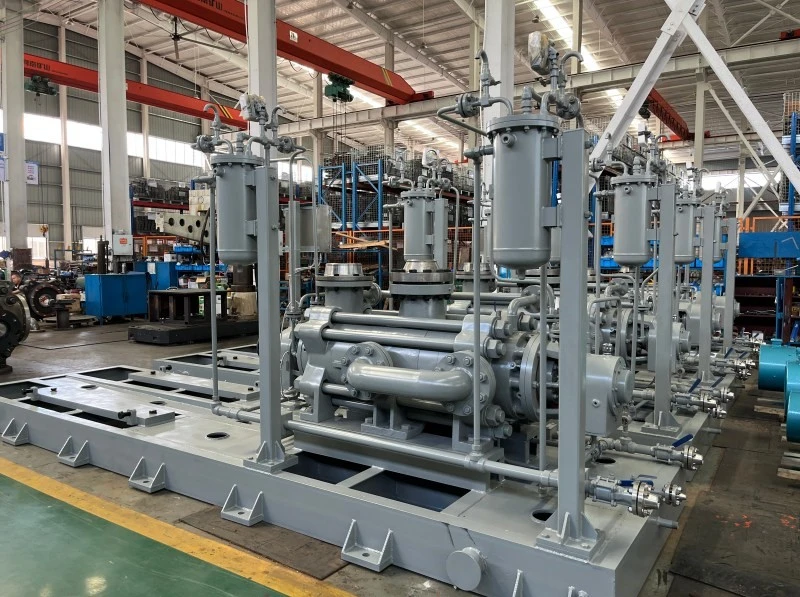
1. What Causes Cavitation in a Boiler Feed Water Pump?
Cavitation occurs when the local liquid pressure inside a pump drops below the liquid's saturated vapor pressure at its operating temperature. Vapor bubbles then form and travel with the water into higher-pressure areas of the impeller.
As the pressure increases, these bubbles collapse rapidly, generating localized shock waves and repeated impacts on the impeller surface. Over time, this can cause pitting, material erosion, noise, and vibration.
For boiler feed pumps, the risk is particularly important because feedwater temperature directly affects vapor pressure. Higher water temperatures require greater attention to suction conditions and available NPSH.
Common operating factors that contribute to cavitation include:
Insufficient inlet pressure or inadequate suction head.
Excessive suction pipe friction losses.
High feedwater temperature.
Low water level in the feedwater tank or deaerator.
Excessive flow or operation outside the recommended operating range.
2. Understanding NPSH: NPSHa, NPSHr and NPSH3
NPSH (Net Positive Suction Head) represents the absolute total pressure head at the pump suction reference level above the liquid's vapor pressure head. It is expressed in meters of liquid.
Three terms are essential for pump selection:
NPSHa – Available Net Positive Suction Head
NPSHa is determined by the pumping system. It represents the suction energy available at the pump inlet after accounting for liquid vapor pressure and system losses.
For a feedwater tank with negligible surface velocity, it can be estimated as:
NPSHa = Pₜ/(ρg) + Hₛ − Pᵥ/(ρg) − Hₗ
Where:
Pₜ = Absolute pressure above the liquid surface in the tank (Pa)
ρ = Liquid density (kg/m³)
g = Gravitational acceleration (m/s²)
Hₛ = Liquid level elevation above the pump suction reference (m)
Pᵥ = Saturated vapor pressure at operating temperature (Pa)
Hₗ = Suction pipeline losses (m)
NPSHr – Required Net Positive Suction Head
NPSHr is a pump performance characteristic specified by the manufacturer. It represents the minimum NPSH required under defined flow, speed, and liquid conditions to meet a specified hydraulic performance criterion.
A lower NPSHr generally indicates better suction performance under comparable test conditions.
NPSH3 – Three Percent Head Drop
NPSH3 is the NPSH value at which the first-stage pump head decreases by 3% during a standard cavitation test. It is commonly used as a reference when presenting pump NPSH performance curves.
Importantly, NPSH3 does not mean that cavitation is completely absent below or above this point.
3. How Much NPSH Margin Does a Boiler Feed Pump Need?
For reliable operation, NPSHa must exceed NPSHr by an appropriate margin.
However, there is no single safety margin suitable for every boiler feed pump. The required margin depends on the pump design, operating range, feedwater temperature, system characteristics, and applicable project specifications.
When evaluating NPSH, engineers should consider:
Minimum and maximum operating flow rates.
Maximum feedwater temperature and corresponding vapor pressure.
Minimum operating liquid level in the feedwater tank.
Actual suction pressure and pipeline resistance.
Startup, shutdown, and variable-speed operating conditions.
Always check the applicable project standards and obtain the pump manufacturer's recommended NPSH margin.
4. How to Prevent Cavitation in Boiler Feed Pumps
Proper system design and pump selection are the most effective ways to reduce cavitation risks.
Optimize Suction Conditions
Maintain sufficient tank pressure and liquid level. Where possible, install the pump below the feedwater tank to provide positive suction head.
Reduce Pipeline Losses
Use appropriately sized suction piping, minimize unnecessary bends and valves, and avoid excessive flow resistance.
Select the Right Pump Configuration
Evaluate first-stage impeller design, pump speed, operating flow, and NPSHr when selecting a high-pressure boiler feed pump.
Verify Actual Operating Conditions
Check NPSHa against the manufacturer's NPSHr curve across the expected operating range, rather than relying only on the rated duty point.
5. High Pressure Boiler Feed Pump Solutions from Sanchang
Hunan Sanchang Pump Co., Ltd. is a China boiler feed pump manufacturer specializing in multistage centrifugal pumps for industrial and power generation applications.
Our product range includes high-pressure multistage boiler feed pumps and high-pressure, high-temperature BB4 pumps.
The DG series boiler feed pump offers flow rates up to 800 m³/h, heads up to 1,000 m, and liquid temperatures up to 135°C. The BB4 boiler feed pump range covers flow rates of 20–540 m³/h and total heads of 16–1,500 m, with configurations designed for higher-temperature service.
With in-house R&D, manufacturing, hydraulic testing, and OEM & ODM capabilities, Sanchang provides pump selection and customized solutions based on actual operating conditions.
Need a reliable boiler feed pump for your project?
Contact Sanchang's engineering team with your required flow rate, head, feedwater temperature, suction pressure, and operating conditions. We can help evaluate pump selection and NPSH requirements for your application.