


Horizontal multistage centrifugal pumps are widely used in industrial water supply, boiler feed, high-pressure water transfer, reverse osmosis (RO) systems, and other demanding applications. Compared with single-stage pumps, they can achieve higher heads through multiple impellers arranged in series.
Understanding the horizontal multistage centrifugal pump working principle , their key components, and selection criteria helps engineers and purchasing managers choose the right pumping solution.
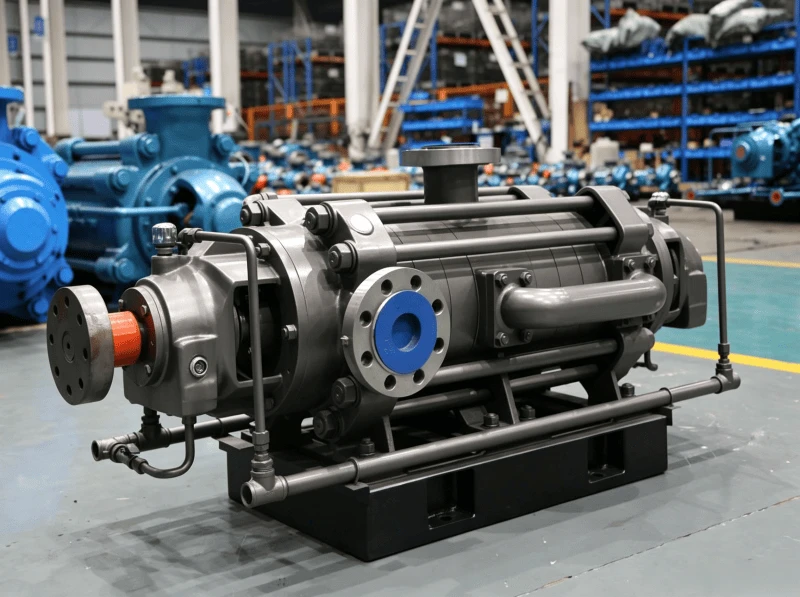
1. What Is a Horizontal Multistage Centrifugal Pump?
A horizontal multistage centrifugal pump is a centrifugal pump equipped with two or more impellers arranged in series, typically mounted on a common shaft.
Unlike a single-stage pump, which uses one impeller, a multistage pump increases fluid pressure progressively through multiple stages. Each stage adds energy to the fluid, enabling the pump to achieve a higher total head.
Depending on the casing and installation design, multistage pumps are available in horizontal and vertical configurations. A horizontal multistage centrifugal pump is commonly used in industrial applications requiring high head, stable performance, and continuous operation.
2. Working Principle of Multistage Centrifugal Pumps
The working principle of a multistage centrifugal pump is based on centrifugal force and energy conversion.
Step 1: Fluid Inlet
The motor drives the pump shaft and impellers at the designed rotational speed. Fluid enters the first-stage impeller through the suction inlet.
Step 2: First-Stage Pressurization
As the impeller rotates, it transfers energy to the fluid, accelerating it from the impeller eye toward the outer diameter.
Step 3: Energy Conversion and Flow Guidance
The fluid passes through the diffuser or guide vane, where part of its kinetic energy is converted into pressure energy. The flow is then directed toward the next impeller.
Step 4: Successive Pressurization
The fluid passes through each subsequent stage, gaining additional energy. The total head is approximately the sum of the head contributions from individual stages under the same operating flow rate.
Step 5: Discharge
After passing through all stages, the pressurized fluid flows through the discharge outlet into the piping system.
3. Key Components of a Multistage Pump
A typical multistage centrifugal pump consists of:
Rotor Assembly: Shaft, impellers, sleeves, and other rotating components.
Casing Assembly: Suction section, stage casings, discharge section, and guide vanes or diffusers.
Shaft Sealing System: Mechanical seals or packing, selected according to operating conditions.
Axial Thrust Balancing System: Balance disc, balance drum, opposed impellers, or other suitable designs, depending on pump construction.
Axial thrust is an important design consideration. Conventional multistage pumps may use a balance disc or balance drum to reduce axial thrust, while some designs use opposed impellers or other balancing arrangements.
A self-balancing multistage centrifugal pump can reduce axial thrust through its specific hydraulic design, potentially eliminating the conventional balance disc or drum, depending on the pump design.
4. Multistage vs. Single-Stage Centrifugal Pumps
Multistage pumps are generally suitable for high-head applications, while single-stage pumps are often preferred for lower-head duties or large-flow applications.
However, the actual flow and head capabilities depend on the pump design, impeller geometry, speed, and operating conditions.
The choice should be based on required flow rate, total head, fluid properties, efficiency, and lifecycle cost.
5. Multistage Centrifugal Pump Selection Tips
When selecting a multistage pump, consider:
Required flow rate and total dynamic head
Fluid temperature, density, viscosity, and corrosiveness
Solid particle content and wear characteristics
Suction conditions and NPSH requirements
Materials, sealing arrangements, and motor specifications
Operating efficiency and maintenance requirements
Clean-water multistage pumps are not generally suitable for abrasive slurry or wastewater containing solids unless specifically designed for these conditions.
6. Choosing a Reliable Multistage Pump Manufacturer
As an experienced multistage pump manufacturer in China, SanchangPump provides industrial centrifugal pump solutions for mining, chemical processing, power generation, and water supply applications.
As a self-balancing multistage centrifugal pump supplier, we offer pump selection support, material customization, sealing options, and engineering solutions tailored to different operating conditions.
Contact SanchangPump to discuss your flow, head, medium, and project requirements.