


When installing a fire pump, one small detail often causes confusion: what type of gauge should be installed on the suction pipe-a pressure gauge, vacuum gauge, or compound vacuum-pressure gauge?
The answer is not simply "any gauge will do." The correct choice depends on the pressure conditions in the suction pipe and whether the gauge can accurately measure them.
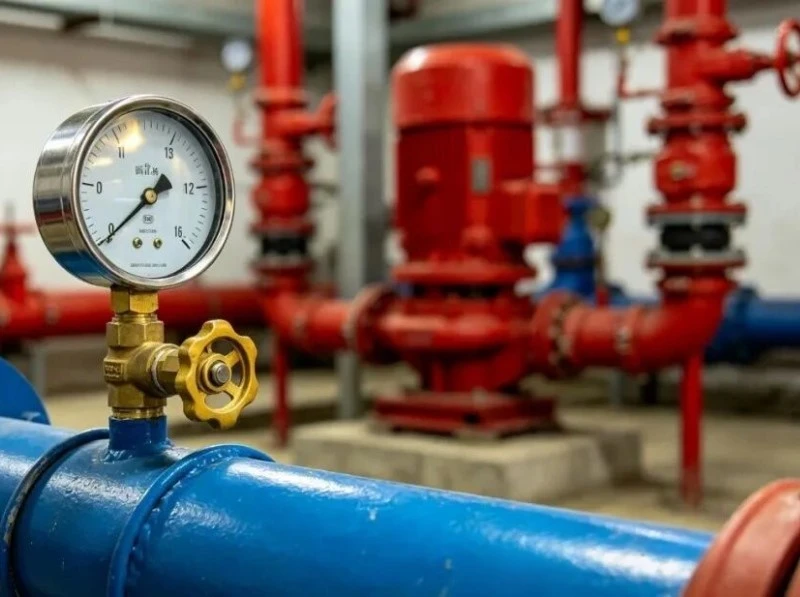
What Does the Standard Say?
According to GB 50974-2014, Code for Design of Fire Protection Water Supply and Hydrant Systems, Clause 5.1.17:
The suction pipe of a fire pump should be equipped with a vacuum gauge, pressure gauge, or vacuum-pressure gauge. The maximum range of the pressure gauge should be determined according to the specific project conditions and should not be less than 0.70 MPa. The maximum range of the vacuum gauge is recommended to be -0.10 MPa.
The standard allows different types of gauges, but the selection should be based on the actual operating conditions of the suction pipe.
The Key Question: Positive or Negative Pressure?
The pressure inside a fire pump suction pipe depends largely on the pump's suction arrangement and the relative elevation between the pump and water source.
Positive Pressure
If the water level is significantly higher than the pump, the suction pipe can remain under positive pressure due to static head.
A pressure gauge can be suitable when positive pressure is the primary condition.
Negative Pressure
When the pump is located above the water level and relies on suction to draw water upward, negative pressure may occur in the suction pipe.
In this case, a conventional pressure gauge may not be able to indicate the vacuum condition correctly. A vacuum gauge is more appropriate.
Both Positive and Negative Pressure
In some installations, the suction pipe may experience both positive and negative pressure during different operating conditions.
For example, depending on the system configuration and operating conditions, a compound vacuum-pressure gauge can measure both vacuum and positive pressure with one instrument.
How to Choose the Gauge?
|
Gauge Type |
Measurement |
Typical Application |
Reference Range |
|
Pressure Gauge |
Positive pressure |
Suction pipe mainly under positive pressure |
Maximum range ≥ 0.70 MPa |
|
Vacuum Gauge |
Negative pressure / vacuum |
Suction pipe mainly under negative pressure |
Maximum range recommended at -0.10 MPa |
|
Vacuum-Pressure Gauge |
Positive + negative pressure |
Conditions where both may occur |
Commonly -0.1 to 0.9 MPa |
The principle is simple: the gauge must be capable of measuring the actual pressure range of the suction pipe.
If the pipe may experience both positive and negative pressure and the conditions are uncertain, a vacuum-pressure gauge can provide a more comprehensive indication and reduce the risk of selecting an unsuitable gauge.
Other Installation Points to Check
Several details should also be considered during installation:
For a pressure gauge on the pump suction pipe, the maximum range should not be less than 0.70 MPa.
The requirements for the discharge-side pressure gauge are different. Its maximum range should generally be at least twice the design working pressure and not less than 1.60 MPa.
The gauge diameter should generally be at least 100 mm.
The connecting pipe should have an internal diameter of at least 6 mm.
A shut-off valve should be installed in front of the gauge for inspection, maintenance, and replacement.
A larger pressure range is not necessarily better. A conventional pressure gauge with a large positive-pressure range still cannot measure vacuum pressure.
Final Takeaway
Selecting a gauge for a fire pump suction pipe is a small detail, but it directly affects whether the system pressure can be monitored correctly.
Before installation, first determine whether the suction pipe will operate under positive pressure, negative pressure, or both. Then select a gauge with a suitable measurement range.
The right gauge is not simply the one that fits the pipe-it is the one that can accurately indicate the actual suction pressure conditions.