
Products
Recommend Products
Contact Us
| Email: | info@sanchangpump.net |
| Hotline: | +86 181 4266 2779 |
| +86 193 1300 1794 | |
|
Wechat: |
+86 181 4266 2779 |
|
WhatsApp: |
+86 181 4266 2779 |
| Address: | No.517,Xiangfu Road |
| Yuhua District, | |
| Changsha City | |
| Hunan Province, P.R.C |

DFP Type Seawater Desalination Pump
Classification:
Multistage Centrifugal Pump
Water Conservancy Industry
Electric Power Industry
Key words:
Seawater Pump
Desalination Pump
Centrifugal Pump
Hotline:
- Product Description
- Performance Parameter
- Installation Drawings
- Installation And Use
- Faults And Solutions
-
- Commodity name: DFP Type Seawater Desalination Pump
Flow Range: 3.75 ~1100 m3/h</br> Head Range: 50 ~1800 m</br> Fluid Temperature: -20 ~150 ℃ (Please specify if higher than 80 ℃)</br> Inlet Pressure: ≤ 0.6MPa</br> Shaft Seal: packing seal, mechanical seal</br> Available Materials: HT200, HT250, QT600, ZG, 304, 316, 316L, 317L, 904L, CD4-MCu, etc</br></br></br>
Overview
China faces a shortage of water resources, with acute water scarcity in coastal regions. Seawater desalination is one of the effective solutions to address the fresh water shortage in these areas. With technological advancement, reverse osmosis (RO) seawater desalination technology has developed rapidly in recent years. It features low capital investment, low energy consumption and short construction cycle, and has become the mainstream seawater desalination technology.
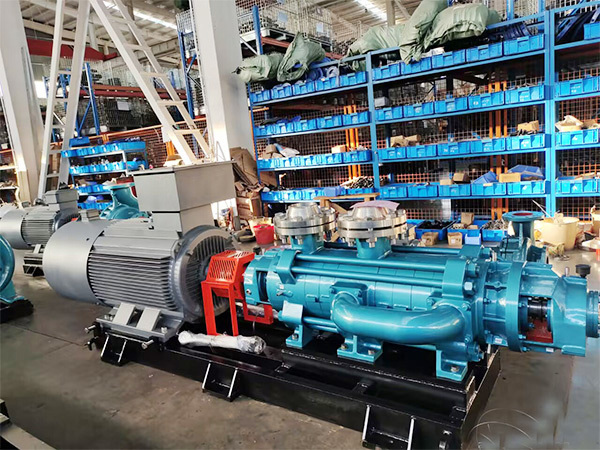
Reverse Osmosis Seawater Desalination (hereinafter referred to as SWRO) leverages the water permeability of semipermeable membranes. Seawater is pressurized by pumps to drive water molecules through the semipermeable membrane against resistance, so as to separate fresh water from seawater. As the core power equipment for seawater desalination, high-pressure seawater desalination pumps provide energy to overcome osmotic pressure in membrane-based desalination systems. The pump efficiency directly determines the energy consumption of the entire SWRO system. Selecting a suitable high-pressure pump plays a vital role in the economic performance of seawater desalination projects.
Selection Guidelines and Key Considerations
To select the right pump, you need to know basic data such as water volume, pump pressure range, and pump performance curves. In the reverse osmosis seawater desalination system, the investment cost accounts for about 25% of the desalinated water cost per ton, and the electricity cost accounts for more than 52%. The two items together account for more than 77% of the water production cost. In the cost of electricity, the energy consumption of the high-pressure pump is the main factor, therefore, the energy consumption of the high-pressure pump is the main factor affecting the cost of product water, according to different desalination scale to choose high-efficiency, appropriate high-pressure pump is the current reverse osmosis seawater desalination industry urgently need to solve the problem. So what are the problems that need to be paid attention to in the selection of high-pressure pumps for seawater desalination equipment?
Common Types and Application Scope
Two major types of high-pressure pumps are widely used in membrane-based seawater desalination systems: multi-stage centrifugal pumps (rotodynamic pumps) and plunger pumps (positive displacement pumps). Generally, multi-stage centrifugal pumps are preferred for large and medium-sized desalination plants, while plunger pumps are mainly applied to small and medium-sized facilities. There is no rigid standard to define the capacity classification. Thanks to the high efficiency of plunger pumps and changed investment costs brought by parallel operation of multiple units, operational energy consumption is prioritized throughout the whole life cycle, especially for BOO and BOT projects.
Common multi-stage centrifugal pumps are divided into two structural types: horizontally split casing pumps and segmental multi-stage pumps.
Structural Features of Horizontally Split Casing Pumps
The pump consists of upper and lower casings that are joined together. Suction and discharge nozzles, partial volutes and flow passages are integrated into the lower casing. Impellers are shrink-fitted onto the shaft and arranged symmetrically, which greatly reduces axial thrust. The thrust bearing bears low axial load, resulting in low vibration. This type of pump allows easy maintenance: the upper casing can be removed directly without disconnecting connecting pipelines during overhaul.
Structural Features of Segmental Multi-Stage Pumps
Each stage is composed of an impeller installed inside a diffuser casing. Diffusers are fastened together via bolts and tie rods, and all stages are assembled in series by stay bolts. Impellers are mounted in a single direction and fixed on the pump shaft with keys. The pump delivers high efficiency at the best efficiency point, yet efficiency drops sharply and vibration increases when operating off-design conditions. Its assembly and disassembly are relatively complicated.
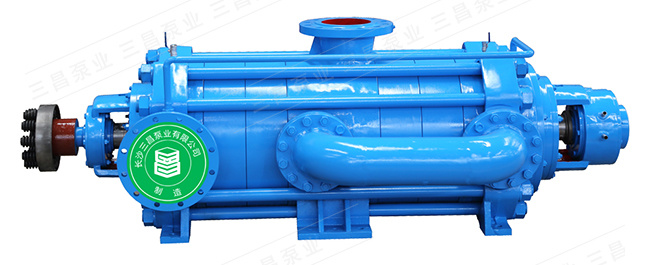
Horizontally split casing pumps show prominent structural advantages. Nevertheless, their high procurement cost makes both types of pumps widely applied in the industry. As a type of positive displacement pump, plunger pumps are extensively used for working conditions requiring high head and low flow, such as the cleaning and petroleum industries.
Multi-stage centrifugal pump and plunger pump compared, due to the different working principle, in practical application, there is a big difference, the following table for the centrifugal pump and plunger pump simple comparison:

Core Principles for High-Pressure Pump Selection
The correct selection of high-pressure pump is the key to the safe and economical operation of the system. For a high-pressure pump of a membrane desalination system, whether it is a plunger pump or a centrifugal pump, the first thing to determine is the material of the flow part, that is, to solve the corrosion problem of the pump in seawater. At present, there are many optional materials. Based on economic considerations, 2507(UNS:S32750) duplex stainless steel is generally selected. The main rated chemical composition is as follows.

As can be seen,Nitrogen is added to 2507 to form a duplex microstructure (austenite + ferrite). This material is recommended primarily to prevent chloride-induced stress corrosion in seawater service.
Large-scale seawater desalination plants are mostly equipped with multi-stage centrifugal pumps. The following factors shall be fully considered during selection:
① Prioritize high-efficiency pumps, as efficiency directly affects the economic performance of the whole system.
② Select pumps with a wide high-efficiency operating range. Since membrane flux declines gradually during operation, the pump operating point will shift accordingly.
③ Choose pumps with stable flow against head variation. Multiple factors affect the osmotic pressure of SWRO systems, requiring pumps to operate across various working points while maintaining stable water production capacity and recovery rate.
④ Give preference to pumps with easy maintenance.
Application of Seawater Desalination Pumps in Liuhuang Seawater Desalination Project
The 100,000 m³/d seawater desalination project on Liuhuang Island is a key provincial project in Zhejiang Province, and also a supporting demonstration project under the National Eleventh Five-Year Key Technology R&D Program, focusing on the development and demonstration of domestically produced core technologies for 100,000 m³/d SWRO systems. Upon full completion, it will become the largest seawater desalination project in China.
The high-pressure pumps provide sufficient inlet pressure for the RO membrane arrays. Combined with energy recovery devices, they maintain stable pressure and flow for normal operation of the membrane system.
Water temperature has a notable impact on membrane flux. To save energy and cut operational costs, load regulation of high-pressure pumps is adopted. After comparing hydraulic coupling and frequency conversion speed regulation schemes, frequency conversion control was finally selected.
① All high-pressure pumps, pipelines and accessories are made of corrosion-resistant materials, fitted with corrosion-resistant mechanical seals.
② Pressure switches are installed at pump suction and discharge sides. The pump will trigger an alarm and shut down in case of excessively low inlet pressure or excessively high outlet pressure.
After comprehensive comparison between centrifugal pumps and plunger pumps, multi-stage centrifugal pumps made of 2205 duplex stainless steel were adopted for this project. Each pump has a capacity of 10,000 m³/d, a head of 600 m and a rated motor power of 1040 kW, operating at 690 kV.
Development Trend of Seawater Desalination Pumps
Domestic manufacturers of high-pressure centrifugal pumps are limited, and fewer products are qualified for SWRO systems. High-pressure pumps for seawater desalination require higher efficiency than conventional multi-stage centrifugal pumps.
In response to market demands, Sanchang Pump Industry has accelerated the R&D of high-pressure multi-stage centrifugal pumps. Our independently developed high-efficiency self-balancing multi-stage pump is a dedicated high-speed and high-pressure product for SWRO systems.
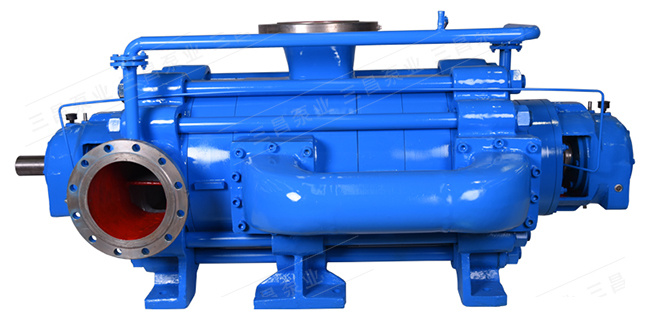
Based on segmental multi-stage pump structure, this pump adopts a balanceless design and optimized hydraulic models, achieving 8,000 consecutive hours of trouble-free operation. Without balance discs, it eliminates disc friction loss and balance recirculation loss, boosting pump efficiency by 3%~14% compared with conventional multi-stage pumps. It fundamentally avoids common failures such as wear of balance discs and seats or rotor seizure caused by failed balance assemblies, and effectively extends service life.
Benefiting from optimized structural strength design, the pump features reliable mechanical seal performance, excellent corrosion resistance, low noise, compact size and easy maintenance. It adopts a combined structure of water-lubricated bearings and rolling bearings to replace the dual rolling bearing structure of traditional multi-stage pumps. The front wear ring of the first-stage impeller acts as a sliding bearing for innovative support. Wetted parts made of duplex stainless steel are also optimized. A single unit can meet the demand of 5,000 m³/d SWRO systems with efficiency exceeding 80%, outperforming similar products at home and abroad.
Technical Advantages of Sanchang High-Efficiency Self-Balancing Multi-Stage Pumps
This series of pumps is designed focusing on practical safety, economic efficiency, trouble-free operation and low maintenance cost throughout the service life. The main design highlights are as follows:
- Adopt advanced modular design. A large number of field-proven components are applied, ensuring high part interchangeability.
- Manufactured with high-strength and high-quality materials. Multiple options for suction/discharge flanges and nozzles are available to withstand high pipe loads. The compact pump casing features a service life 5 times longer than ordinary castings. Impellers and diffusers for wetted parts are precision-cast with smooth surfaces, raising efficiency by more than 2% compared with conventional castings.
With the continuous development of domestic high-pressure pump technology for seawater desalination, Sanchang Pump Industry will further increase investment in R&D and production. Our self-balancing multi-stage high-pressure pumps will be widely applied in various seawater desalination projects in the future.
-
Flow Range: 3.75 ~1100 m3/h
Head Range: 50 ~1800 m
Fluid Temperature: -20 ~150 ℃ (Please specify if higher than 80 ℃)
Inlet Pressure: ≤ 0.6MPa
Shaft Seal: packing seal, mechanical seal
Available Materials: HT200, HT250, QT600, ZG, 304, 316, 316L, 317L, 904L, CD4-MCu, etc
-
Outline Installation Drawing of DFP Type Seawater Desalination Pump

Previous Page
Customer Case
Product Consulting
If you are interested in our products, please leave your email, we will contact you as soon as possible, thank you!



Hunan Sanchang Pump Co., Ltd.
| Email: | info@sanchangpump.net |
| Hotline: | +86 181 4266 2779 |
| +86 193 1300 1794 | |
| Mobile/Wechat/WhatsApp: | +86 181 4266 2779 |
| Address: | No.517,Xiangfu Road, Yuhua |
| District, Changsha City | |
| Hunan Province, P.R.C |
