


What Is a Split Case Pump?
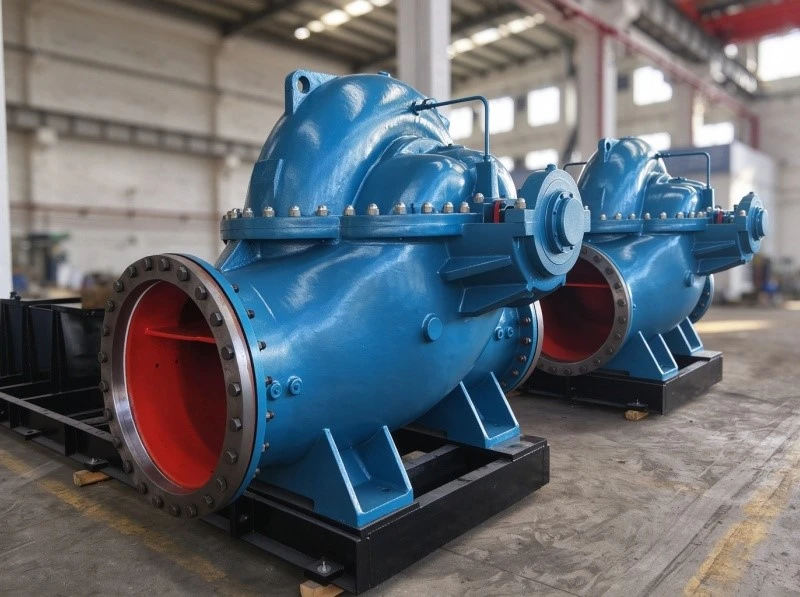
A split case pump is a centrifugal pump with a casing divided into two sections along the shaft centerline. This horizontal split design allows maintenance personnel to access internal components, including the impeller, shaft and bearings, by removing the upper casing, often without disconnecting the connected pipework or moving the motor.
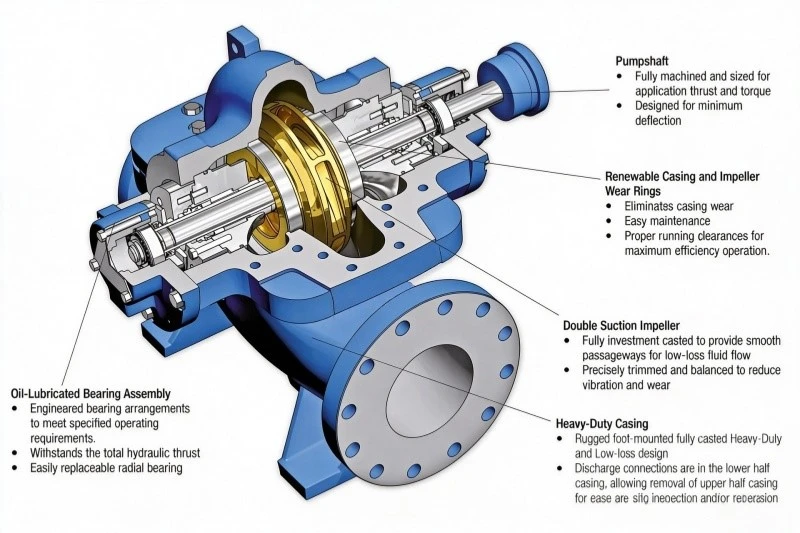
Most horizontal split case pumps use a double suction impeller, allowing liquid to enter from both sides. This arrangement helps balance axial thrust, reduces the load on bearings and supports stable operation in high-flow applications.
Split case pumps are widely used in municipal water supply, power generation, irrigation, industrial water circulation and other applications requiring reliable fluid transfer.
Working Principle of a Double Suction Split Case Pump
A split case centrifugal pump operates through centrifugal force. Liquid enters the pump through the suction nozzle and flows into both sides of the double suction impeller.
As the impeller rotates, centrifugal force moves the liquid outward into the pump casing. The casing collects and directs the liquid toward the discharge outlet, converting velocity energy into pressure energy.
The double suction design offers several operational benefits:
Axial Thrust Balance: Opposing hydraulic forces from both impeller sides help reduce axial thrust and bearing loads.
Lower NPSHr Potential: Dividing the flow between two impeller inlets reduces inlet velocity and can improve suction performance.
High Flow Capacity: The double suction configuration is suitable for transferring large volumes of liquid.
Stable Operation: Balanced hydraulic forces help reduce vibration and support long-term operation when the pump is properly selected.
Actual efficiency and NPSHr depend on pump design and operating conditions. Selection should always be based on the manufacturer's performance curves.
Main Types of Split Case Pumps
Split case pumps can be classified by casing arrangement and impeller configuration.
The casing is divided horizontally, with the shaft arranged horizontally. This is a widely used configuration for large-flow water supply, power plant cooling systems and industrial circulation. Its accessible casing design simplifies inspection and maintenance.
2. Single-Stage Double Suction Pump
Equipped with one double suction impeller, this pump is commonly selected for high-flow, relatively low- to medium-head applications, including municipal water supply, irrigation and cooling water systems.
3. Multistage Split Case Pump
Multistage configurations use multiple impellers to increase discharge pressure and head. They can be considered for applications requiring higher heads, subject to the specific pump design.
Industrial Applications
Split case pumps are used across industries where dependable, high-volume fluid transfer is essential.
Municipal Water Supply: Transferring treated water into distribution networks and water supply systems.
Power Generation: Circulating cooling water and supplying auxiliary water systems.
Agricultural Irrigation: Delivering large volumes of water through irrigation networks and pumping stations.
Industrial Plants: Supporting cooling water circulation and suitable process water transfer in chemical, petrochemical and steel facilities.
Fire Protection: Supplying water in industrial and commercial fire protection systems when the selected pump meets the applicable requirements.
HVAC Systems: Circulating chilled and hot water in large commercial buildings and industrial facilities.
Split Case Pump vs. End Suction Pump
The main differences between split case pumps and end suction pumps lie in their casing design, impeller configuration, flow capacity and maintenance requirements.
|
Comparison |
Split Case Pump |
End Suction Pump |
|
Casing Design |
Horizontally split casing for easy internal access |
Compact, non-split casing design |
|
Impeller Configuration |
Typically double suction |
Typically single suction |
|
Flow Capacity |
Suitable for high-flow applications |
Commonly used for small- to medium-flow applications |
|
Axial Thrust |
Double suction design helps balance axial thrust |
Generally experiences greater hydraulic axial thrust |
|
Maintenance |
Upper casing can be removed for internal inspection |
Maintenance may require disconnecting pipework and moving the motor, depending on installation |
|
Installation Space |
Generally requires a larger installation footprint |
More compact structure, requiring less space |
|
Typical Applications |
Municipal water supply, power plant cooling and industrial water transfer |
General water supply, industrial circulation and smaller pumping systems |
How to Select the Right Split Case Pump
Proper pump selection starts with the actual system requirements, not simply the rated capacity.
Key factors include:
Flow Rate and Head: Determine the required operating flow and total dynamic head.
Suction Conditions: Check available NPSH against the pump's required NPSH.
Liquid Properties: Consider temperature, corrosiveness and suspended solids.
Materials and Sealing: Select suitable casing, impeller and shaft sealing materials.
Installation and Maintenance: Evaluate foundation space, motor arrangement and maintenance access.
Reviewing the pump performance curve and actual operating conditions with the manufacturer helps ensure reliable operation and avoid unnecessary energy and maintenance costs.
Looking for a Suitable Split Case Pump?
Hunan Sanchang Pump Co., Ltd. provides industrial centrifugal pump solutions for water supply, power generation, mining and other demanding applications.
Contact our engineering team with your required flow rate, head, liquid properties and operating conditions. We can assist with pump selection and recommend a suitable configuration for your project.
Request a Quote for Your Split Case Pump Requirements.